

Singapore Manufacturing Recovery in the AI Wave: Structural Opportunities in the Semiconductor Supply Chain
Keywords: artificial intelligence, semiconductors, Singapore manufacturing, data centers, AI servers, electronics manufacturing, precision engineering, supply chain upgrade
Introduction
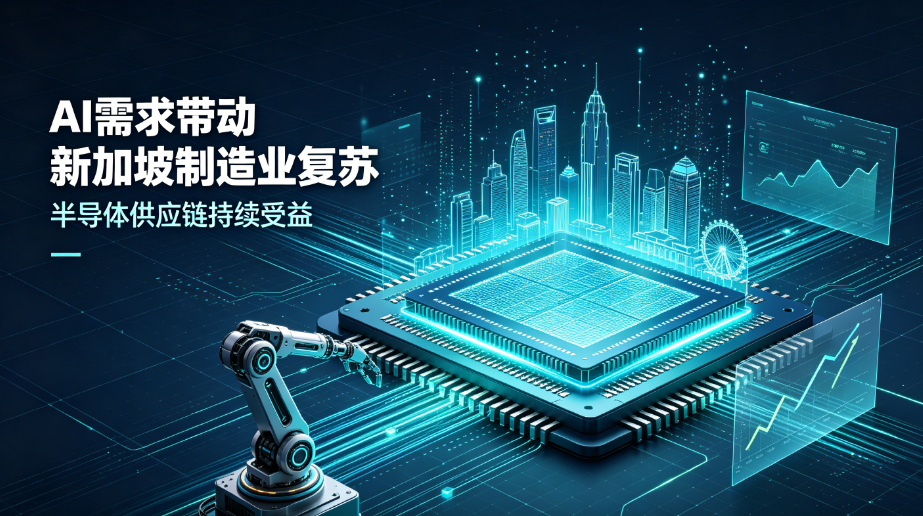
As the global AI industry enters a period of rapid expansion, compute infrastructure is becoming the core of the new round of technology competition. Whether it is training generative AI models or running large-scale inference applications, all of it depends on coordinated support from high-performance chips, advanced packaging, memory devices, server systems and data-center infrastructure. In this process, Singapore, as a major Asian hub for electronics manufacturing and semiconductor supply chains, is gaining a new round of growth momentum.
At the macro level, AI demand is not just lifting one segment; it is moving along the chain of "chip design - wafer fabrication - advanced packaging - server assembly - data-center deployment," raising the intensity of related industrial activity across the board. For Singapore, with its solid manufacturing base, strong supply-chain organization and high openness to foreign capital, this round of demand expansion is not only lifting electronics orders, but also benefiting precision engineering, industrial equipment and logistics services at the same time.
How AI Compute Demand Translates into Manufacturing
The boost that AI gives to manufacturing is not simple end-consumer growth, but a classic capex-driven expansion. An AI server is worth far more than a traditional server, and it usually integrates high-compute GPU/AI accelerators, high-bandwidth memory, complex cooling modules and high-speed interconnect components. All of that significantly raises demand for electronic components and systems integration. At the same time, data-center construction also drives large-scale purchases of power management systems, temperature control systems, racks, optical modules and network equipment.
This change in demand is reflected directly in manufacturing orders. First, higher chip purchases lift demand for semiconductor packaging and testing, PCB assembly and precision parts processing. Second, AI servers have short production cycles and fast iteration, putting higher demands on process stability, yield control and delivery capability, pushing related firms to accelerate automation upgrades. Third, data-center deployment often goes hand in hand with regional supply-chain restructuring, and companies prefer manufacturing bases near Southeast Asia with efficient transport and stable policy settings to shorten delivery times and reduce supply-chain risk.
So the impact of the AI boom on manufacturing is, in essence, a re-rating of the industry chain centered on compute power. Singapore is benefiting because of its very strong node position in the high-end manufacturing chain.
Why Singapore Is a Key Beneficiary of the AI Industry Chain
Although Singapore has limited land, it occupies a unique position in the global semiconductor and electronics manufacturing system. Its advantage is not low-cost manufacturing, but high value-added, high-reliability and highly integrated industrial capability. First, Singapore has a relatively complete semiconductor ecosystem covering wafer fabrication, equipment maintenance, materials supply, testing and packaging, module assembly and more, which supports multinational tech firms in regional production and supply-chain management.
Second, Singapore's long-built high-end manufacturing capability is especially evident in precision engineering, automated assembly and industrial quality control. AI servers and advanced chip-related equipment demand extremely high standards for production environment, cleanliness and process consistency, and Singapore's manufacturing sector already has a high-standard production system and stable engineering management capability, giving it a clear advantage in high-complexity manufacturing scenarios.
Third, Singapore offers an excellent business environment and an international financial and logistics system. For multinational firms, choosing a production and supply-chain node is not just about capacity; they also look closely at policy certainty, intellectual-property protection, international shipping efficiency and talent supply. Singapore performs strongly on all of these, making it suitable not only as a manufacturing base, but also as a regional supply-chain management center and a technical collaboration platform.
The Ongoing Upside in the Semiconductor Supply Chain
AI's pull on the semiconductor supply chain is clearly structural and long-lasting. Compared with traditional consumer electronics, AI chips have higher technical barriers, shorter life cycles and much higher unit value, which means the high-tech parts of the supply chain will remain in expansion mode for years. In particular, advanced process nodes, advanced packaging and high-speed interconnect components are likely to be the most growth-friendly areas.
Against this backdrop, the biggest benefits for Singapore's electronics manufacturing sector show up in three ways. First, as chip companies expand capacity and raise inventory safety levels, demand for local manufacturing and testing services will rise. Second, AI server and data-center construction drives growth in procurement of high-frequency, high-speed components, cooling systems and power-management modules, boosting precision engineering and electronics assembly work. Third, as companies think about supply-chain resilience, they want multi-node production systems in Asia, and Singapore, as an efficient transit and highly reliable manufacturing base, fits the role of a regional hub.
More importantly, this is not just a short-term order rebound; it may evolve into industrial upgrading. As AI equipment moves toward higher density, higher power consumption and faster connectivity, manufacturers must raise automation, testing and process-integration capabilities in step. In other words, AI demand does not just bring business growth; it also pushes Singapore manufacturing up to a higher technological level.
Real Challenges Behind the Upgrade
Even though the outlook is positive, Singapore still faces several challenges if it wants to keep capturing the spillover benefits of AI. First, the global semiconductor cycle remains highly volatile, and if AI investment slows temporarily, related manufacturing orders could adjust too. Second, manufacturing advanced chips and AI servers requires a lot of energy, land and specialized talent, so Singapore must use more efficient industrial organization to get more output from its limited resources. Third, global supply-chain competition is intensifying, with other Asian economies also increasing semiconductor and data-center investment. Singapore needs to keep sharpening its differentiated strengths instead of relying only on its existing position.
So the key for Singapore in the future is not just "absorbing orders," but further strengthening its system capabilities in high-end manufacturing, R&D collaboration and supply-chain coordination. For example, by expanding industrial automation, deepening joint R&D with global chip firms and building out advanced packaging and testing capabilities, Singapore can maintain a long-term edge in the AI era.
Conclusion
Overall, the rapid development of AI is triggering a new round of change in the global manufacturing landscape, and Singapore is well placed in that shift. Rising demand for AI servers, data centers and advanced chips is lifting electronics manufacturing, precision engineering and the semiconductor supply chain across the board, giving Singapore manufacturing new growth momentum.
At a deeper level, this recovery is not a traditional cyclical rebound; it is a structural opportunity driven by the expansion of compute infrastructure. With its complete industrial chain, international business environment and high-end manufacturing capability, Singapore is not only benefiting from current order growth, but is also likely to play a more important regional hub role in the future restructuring of the AI industry chain. For global tech firms, Singapore is no longer just a manufacturing location; it is a key node connecting technology, capital and supply-chain resilience.