

Apple Under Price-Hike Pressure as Memory and Storage Costs Surge: Cost Restructuring in the AI Era
Keywords: Apple, Tim Cook, price hikes, memory shortages, storage chips, artificial intelligence, consumer electronics, supply chain
Introduction
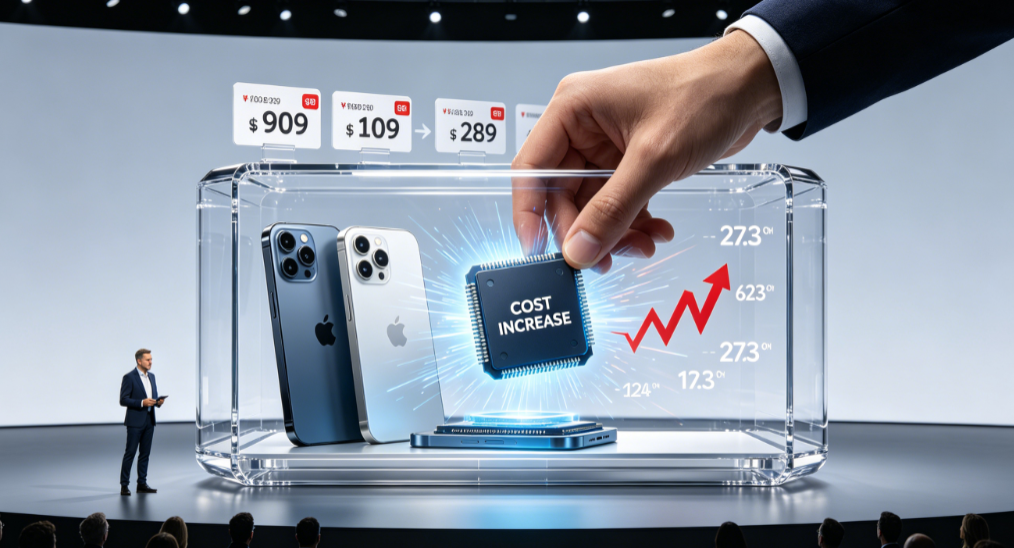
As the global tech industry accelerates into the AI era, the semiconductor supply landscape is undergoing a profound shift. Recently, Apple CEO Tim Cook said publicly that because memory and storage chip costs continue to surge, the company plans to raise prices on some products to cope with rising manufacturing and procurement pressure. He put it bluntly: “Unfortunately, price increases are inevitable.” The statement not only suggests possible changes in Apple’s future pricing strategy, but also reflects the cost restructuring that the entire consumer electronics industry is facing as a result of AI demand.
For years, Apple has benefited from strong brand premium, supply-chain management, and a high-margin structure, giving it considerable ability to absorb cost pressure. But when the price of key components keeps rising and supply-side tightness cannot be eased quickly, even a giant like Apple must revisit its pricing system. More importantly, Apple’s remarks are not an isolated event; they are a snapshot of what consumer electronics companies around the world are dealing with.
1. Price Hikes Are Not Just an Apple Choice, but a Concentration of Industry Cost Pressure
In the interview, Cook admitted that Apple has been trying to slow the pass-through of rising costs to consumers, hoping to protect users as much as possible from higher prices, but the situation has become unsustainable. From an industry logic standpoint, this is not surprising. In recent years, AI applications have expanded rapidly, data-center construction has surged, and large volumes of high-bandwidth memory and storage chips are being prioritized for servers, cloud computing, and AI training equipment, squeezing the supply available for consumer products.
Memory and storage chips have always been among the most volatile core components in electronics. Once upstream capacity is absorbed by AI servers in large quantities, consumer electronics makers face multiple challenges at once: higher purchase costs, longer lead times, and weaker bargaining power. For Apple, core products like iPhone, Mac, and iPad all depend heavily on stable memory and storage supply, so any upstream price fluctuation can quickly feed through to retail prices.
It is worth noting that Apple did not announce a specific timing, magnitude, or product list for the price hike, suggesting the company is still balancing market acceptance against profit protection. Apple’s next major launch event is expected in September, when the iPhone 18 series may debut, possibly including a new foldable iPhone. The market generally believes Apple will likely test the waters first with Mac and iPad lines, which is consistent with its move in May to raise the starting price of the Mac mini.
2. The AI Wave Has Changed the Logic of Semiconductor Resource Allocation
If past chip shortages were more closely tied to the pandemic, geopolitics, and swings in traditional electronics demand, this round of price pressure is more directly linked to the AI boom. AI training and inference place extremely high demands on memory bandwidth, capacity, and stable supply, so high-bandwidth memory products have become a major battleground for chipmakers. As compute investment keeps rising, semiconductor manufacturers naturally shift more capacity toward high-margin, high-demand segments.
The result of this resource reallocation is tighter supply and higher prices for consumer memory and storage chips, which in turn raises the cost of PCs, tablets, smartphones, and other end products. Industry groups representing automakers, retailers, and electronics firms recently warned that rising memory-chip demand could disrupt supply chains and push up U.S. consumer prices. That warning shows the impact is not limited to tech alone; it will spread across manufacturing, retail, logistics, and final consumption.
Microsoft’s recent product pricing also indirectly confirms this trend. Its new 13-inch Surface Pro starts at $1,499 and the Surface Laptop starts at $1,599, both notably higher than the previous generation. The market widely believes AI-driven memory shortages are one of the key reasons. In other words, the entire PC industry is undergoing a synchronized pricing adjustment, not a series of isolated brand-level price hikes.
3. Why Apple Must Be Careful About Raising Prices
For Apple, price increases are not just a simple cost pass-through; they are a complex decision involving brand positioning, consumer psychology, and market share. Apple products are known for premium positioning, and users tolerate higher prices than they do for mainstream consumer electronics brands, but that does not mean Apple can raise prices indefinitely. Especially in a smartphone market with slowing growth, longer replacement cycles, and consumers paying more attention to value for money, price changes can directly affect sales structure.
That is why Apple is cautious on pricing. On one hand, the company needs to protect margins and avoid key component cost inflation eating into its financial performance. On the other hand, it must preserve long-term brand appeal and avoid overpricing that could weaken user loyalty. Cook said Apple is willing to use its strong balance-sheet strength to help the industry expand supply, which suggests the company may use prepayments or long-term procurement agreements to lock in supply rather than passing all the pressure directly to consumers.
Still, Cook clearly said Apple has no plan to build its own memory and storage chip factories. That means the company will continue to rely on its supply-chain coordination model rather than becoming a capital-heavy manufacturer. For Apple, investing in its own fabs would be extremely costly and would fundamentally change its long-standing business model of relying on specialized suppliers. So in the short term, the most realistic approach remains using financial strength to secure more upstream resources while making moderate adjustments to end-product pricing.
4. High Memory Prices May Become a Mid-Term Industry Norm
From a broader perspective, this round of memory price increases is not a short-term fluctuation, but more like a mid-term structural shift. S&P Global Ratings said in a June 11 report that due to a surge in AI demand and the resulting supply tightness, memory prices are likely to stay elevated, and the memory-chip market will remain prosperous at least through 2028. That view suggests consumer electronics companies may face sustained cost pressure for several years.
If that trend holds, corporate responses will not be limited to one-off price hikes. They will shift toward comprehensive product-mix optimization: increasing the share of higher-value models to offset cost inflation, reducing low-margin lines, optimizing storage configurations, and extending product lifecycles to balance volume and profit. For consumers, buying electronics in the future may mean more visibly paying “higher prices for the same performance.”
At the same time, supply-chain companies need to rethink capacity planning. The rapid rise of AI has certainly boosted chip demand, but if consumer-product supply is squeezed for too long, end-market price transmission may eventually suppress overall demand and create a new imbalance. Therefore, building a more resilient capacity-allocation mechanism between AI compute expansion and consumer electronics supply will become a major industry challenge.
Conclusion
Tim Cook’s comment that price increases are inevitable is both Apple’s response to real cost pressure and a snapshot of the new structural shock facing consumer electronics. Under the AI wave, memory and storage chips have become one of the most scarce core resources, and supply tightness, rising prices, and capacity reallocation are reshaping the pricing logic of the whole industry.
For Apple, price hikes are not a proactive choice, but a difficult balance among margin protection, brand positioning, and market competition. For the industry, this means the battle over chip supply, product pricing, and consumer affordability will continue for years. In this new round of industry adjustment driven by AI, those who manage supply chains better, secure key resources, and optimize product structure will be better positioned.