

Fed Holds Steady Again, What Signal Does the Dot Plot Turn Hawkish Send?
Keywords: Federal Reserve, rate decision, dot plot, rate-hike bets, inflation pressure, financial markets, Trump, monetary policy
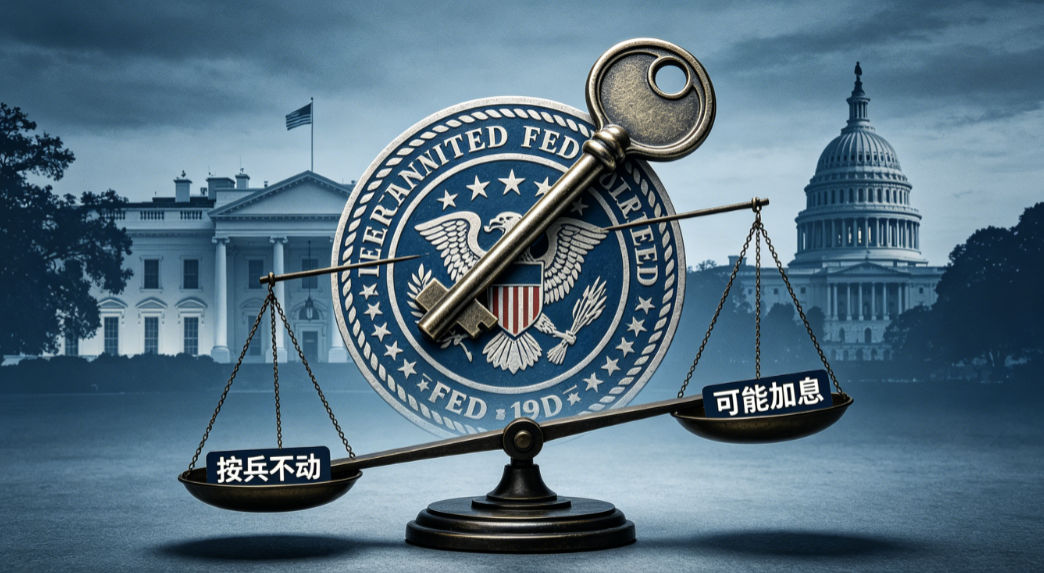
In the early hours of Thursday Beijing time, the Fed announced as expected that it would keep the federal funds target range unchanged at 3.5% to 3.75%, marking the fourth straight meeting with no move. On the surface, the decision continued the recent wait-and-see stance. But the newly released dot plot sent a much stronger tightening signal: Fed officials as a group now expect a rate hike this year, a clear shift from the earlier expectation of one cut. The gap between the policy message and market expectations is now redefining the path of monetary policy in the coming months.
Policy Shift: From Waiting to a More Hawkish Stance
The dot plot has long been an important window into the Fed’s internal consensus. This time, among the 18 participants, 9 expect at least one rate hike in 2026, including 3 who see one hike, 5 who see two hikes, and 1 who sees three. Compared with the earlier easing bias, this change means the Fed’s concern about sticky inflation, economic resilience, and financial conditions is rising. In other words, although rates are being held steady for now, further tightening has not been ruled out and is already entering the core of the policy discussion.
That also explains why the market response was so sensitive. For bonds, equities, and the dollar, “unchanged” does not mean “tightening is over,” while a hawkish dot plot may be more forward-looking than an actual hike. It reminds investors that rates may stay high for longer than expected, and the policy focus may shift from “when cuts begin” to “whether another hike is still needed.”
New Signals Under Warsh: Reform and Communication Go Hand in Hand
New Chair Warsh’s remarks also deserve attention. Unlike his predecessor, he did not make a clear commitment to a future rate path after the meeting. Instead, he stressed that major reforms are coming, seemingly warming up the market for a policy-framework reset inside the Fed. At the press conference, he refused to give a clear direction for rates and did not specify whether he had spoken directly with the president, but he did acknowledge regular meetings with Treasury Secretary Scott Bessent. This both follows the Fed’s institutional practice and suggests the new leadership is trying to balance independence with communication and coordination.
It is worth noting that Warsh had already said at his confirmation hearing that he would work closely with the government on non-monetary-policy issues. That means the Fed may not only face inflation and employment challenges, but may also speed up adjustments on regulation, fiscal coordination, and institutional reform. For markets, the real change may not lie only in rates themselves, but in the reshaping of the Fed’s decision-making logic and communication style.
Trump’s Calm and the Market’s Caution
Unlike his past frequent pressure campaigns, President Trump showed rare restraint this time. When asked about the Fed holding rates unchanged, he simply replied, “It’s okay, whatever.” This reflects both his trust in Warsh and some expectation for the direction of the new Fed leadership. Trump has repeatedly criticized Powell before, with his core demand always being lower rates to stimulate real estate, boost the economy, and reduce government borrowing costs.
The market, however, will not relax just because the White House sounds mild. Bob Michele of JPMorgan Asset Management said bluntly that with half of the committee expecting a hike this year, this is “a real warning sign.” His view points to the key issue: if the Fed is already preparing for hikes internally, then the current pause is only a brief intermission before a bigger policy move.
Conclusion: The Real Test Has Only Just Begun
Overall, the signals from this decision were not mild. Leaving rates unchanged was only the surface move; the hawkish dot plot was the more important policy marker. With Warsh now fully at the Fed’s helm, policy may enter a new phase that puts more emphasis on discipline, rules, and structural adjustment. For investors, the question to watch is not only whether the next move is a hike, but whether the Fed is redefining its priorities for inflation, growth, and financial stability.
In this backdrop, market volatility may intensify, and asset-pricing logic may be rewritten accordingly. The Fed’s real test, clearly, still lies ahead.