


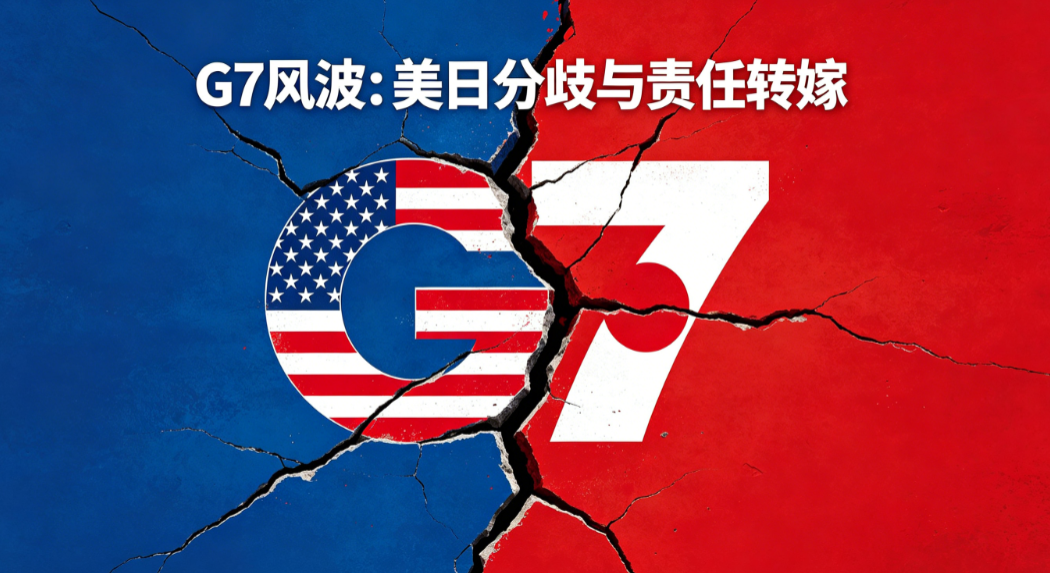
Pearl Harbor Old Scores and Allies' Bills: U.S.-Japan Rift and Blame Shifting Behind the G7 Turmoil
Keywords: G7 summit, Trump, Sanae Takaichi, U.S.-Japan relations, Pearl Harbor, Iran reconstruction, allied burden-sharing, energy security, international politics
Introduction
In international politics, history never really disappears; it often returns to the negotiating table in another form. Around a recent diplomatic spat during the G7 summit, the outside world once again saw the complex and delicate relationship between the United States and Japan: on one side, Washington's hard-line posture in Middle East military action and its "allies should share the burden" logic; on the other, Japan's sensitive reaction to historical memory, national dignity, and real-world interests. On the surface, it was a quarrel sparked by careless remarks; at a deeper level, it exposed multiple tensions in the U.S.-Japan alliance over security, the economy, and historical understanding.
1. Why Pearl Harbor Still Matters in Japanese Diplomacy
More than eighty years have passed since Pearl Harbor, yet for Japanese society it is not a historical symbol to be joked about casually. For the United States, Pearl Harbor represents a national trauma and the starting point of wartime mobilization; for Japan, it is closely tied to defeat, reflection, and the rebuilding of the postwar order. Any statement comparing current military action with Pearl Harbor is highly likely to trigger strong backlash from Japanese politicians and public opinion.
If the reports are accurate, then Trump's repeated use of phrases like "catch them off guard" and "Pearl Harbor" in interactions with Japanese leaders was not merely loose talk, but more like a coercive style of negotiation: using historical humiliation and emotional provocation to force concessions on real-world interests. In U.S. domestic politics, that may be seen as "strong diplomacy," but among allies it is often interpreted as eroding the foundation for cooperation.
Sanae Takaichi's fierce reaction on the spot was not just emotional; it reflected the extreme sensitivity of Japanese politicians to a "historical red line." For Japan, if even historical dignity cannot be defended, its bargaining space in future bilateral cooperation will only shrink further.
2. The "Allies Should Share the Burden" Logic: A Realistic Projection of U.S. Strategy
More worth watching than the historical dispute is Washington's cost-sharing logic in the Middle East crisis. For years, U.S. diplomacy has verbally emphasized alliance systems, while in practice it has increasingly insisted that "benefits and costs must be recalculated." Especially in military intervention, regional reconstruction, and economic aid, the U.S. has preferred to ask allies to share the burden, or even to bear the main financial pressure.
This logic is not new. Whether in NATO defense spending, Asia-Pacific security deployments, or postwar reconstruction in the Middle East, Washington has increasingly stressed that "no one can free-ride." The problem is that when the U.S. leads military action, allies often do not truly participate in the decision-making, yet may end up as the main payers of the political and economic bills afterward. That structural asymmetry is a long-standing source of dissatisfaction for many allies.
If arrangements around an Iran reconstruction fund are real, its symbolic meaning is far greater than the money itself. It means: the war is launched by the U.S., geopolitical risks are absorbed by regional states, and reconstruction costs are then turned into an "international cooperation project" and layered onto allies, companies, and relevant countries. In form, it looks gentler; in essence, it is still a classic form of responsibility outsourcing.
3. Why Japan Is Most Easily Pushed to the Front Line
Japan is especially passive on issues like this mainly because both its energy structure and security structure are deeply dependent on the external environment.
First, on energy, Japan has long relied heavily on Middle Eastern crude imports and is highly sensitive to the stability of the Strait of Hormuz. For a country with a mature industrial system and very low energy self-sufficiency, any ripple in the Middle East can quickly pass through to domestic prices, manufacturing, and supply-chain security. That is precisely why Japan has little room to stand aside on overseas energy security issues; it can only choose the side with the least loss in a passive position.
Second, on security, Japan is one of Washington's most important Asian allies, yet its security policy remains deeply embedded in the U.S.-Japan alliance framework. Japan can stress autonomy in diplomatic settings, but it is hard to fully break away from America's strategic rhythm on key issues. Especially when the U.S. binds Middle East issues to allied responsibility, Japan is often the easiest place to be asked to pick up the tab: it cannot openly break with Washington, yet it also finds unconditional political and fiscal support difficult.
This also explains why Japanese public opinion is so sensitive to a "sky-high bill." For ordinary Japanese people, the real issues are economic pressure, inflation, pensions, and fiscal sustainability. If the government is forced under diplomatic pressure to shoulder excessive costs, social backlash is almost unavoidable.
4. The Alliance Dilemma Behind Historical Humiliation and Real-World Bargaining
What deserves real alarm is not a dinner-table argument, but the alliance dilemma exposed by the argument: the U.S. is growing more accustomed to treating alliances as a cost-shifting tool, while Japan is still trying to balance dependence and autonomy. On the surface, the two sides maintain close cooperation; in reality, the relationship is clearly asymmetric.
Trump-style diplomacy's core feature is turning international relations directly into business terms and bill terms. He likes to replace institutional language with transactional language, using "how much should you pay" instead of "how do we share responsibility." This style may win support in domestic politics because it matches some voters' instinctive desire to "make allies pay more"; but internationally, it keeps undermining allied trust in U.S. commitments.
Japan's problem is that, on the one hand, it wants the security guarantee of the U.S. alliance, while on the other, it does not want to lose control over historical dignity and fiscal responsibility. So whenever Washington places historical trauma and real-world bills side by side, Japan looks especially awkward: it cannot hit back hard, yet it cannot fully accept the terms either.
Conclusion
From old Pearl Harbor scores to Middle East reconstruction bills, the essence of this incident is not a simple quarrel, but a concentrated eruption of long-standing structural contradictions in U.S.-Japan relations. The U.S. emphasizes power, efficiency, and burden-sharing; Japan cares about history, face, and its real capacity to bear costs. The two may still appear to be in the same camp, but they have entirely different understandings of "alliance responsibility."
If Pearl Harbor reminds Japan that history is not easily forgotten, then the Middle East bill reminds Japan that in great-power games, allied status does not automatically mean security. It may instead mean more passive burden. Mature diplomacy is not just about maintaining ties, but about defending the bottom line, drawing clear boundaries, and securing as much room for autonomy as possible within complex alliances.
Whether U.S.-Japan relations can remain stable in the future will not depend on a reconciliation gesture at one dinner, but on whether both sides can redefine the alliance: is it a partnership of mutual support, or a one-way structure led by the U.S. and paid for by allies? Until that question is answered, disputes and bills like this are likely to keep reappearing.