


Singapore Stocks Open Under Pressure as STI Edges Lower and Cash-Side Sentiment Rises
Keywords: Singapore stocks, Straits Times Index, opening decline, CapitaLand Integrated Commercial Trust, Thai Beverage, market sentiment, turnover
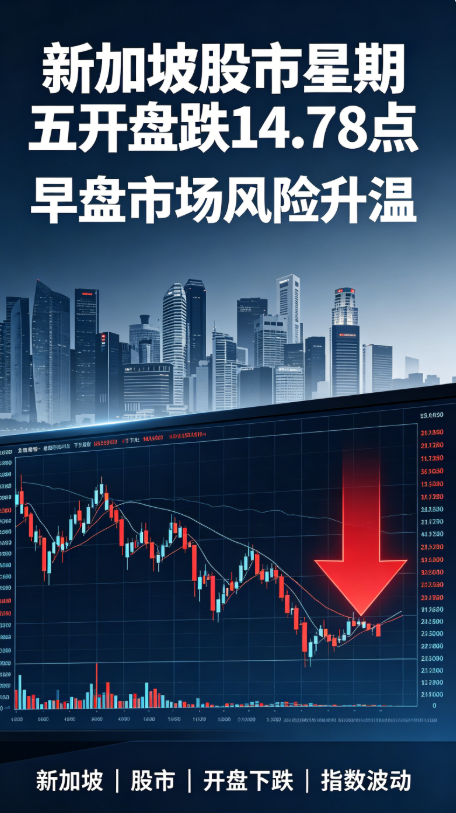
On Friday, June 26, Singapore stocks opened weaker and the market extended its cautious tone. As of 9:03 a.m., the Straits Times Index (STI) had fallen 14.78 points to 5,204.18, down 0.28%. While the decline was not large, the broad weakness among constituents and the clear lead of losers over gainers show that investors are still favoring defense and caution. Early trading is under visible pressure.
Morning Pullback Reflects a Cautious Mood
The STI's early decline first reflects the local market's high sensitivity to external uncertainty. With global macro conditions still full of variables, investors often prefer to trim positions at the open and wait for clearer economic data, policy signals, or overseas market direction before making fresh moves. Near month-end or quarter-end, institutional funds also tend to rebalance portfolios, which can add to opening volatility.
At the index level, the STI fell only 0.28%, but the constituent breakdown tells a less even story. Of the 30 STI constituents, only five opened higher, seven were unchanged, and 18 fell. That means most heavyweight stocks were unable to provide meaningful support. For a blue-chip index like the STI, this kind of structure, with a few gainers and many pullbacks, usually signals low risk appetite and a tilt toward defense or cash.
Active Turnover but No Clear Direction: The Market Is Still Digesting
By 9:03 a.m., market turnover stood at 61.21 million shares, with value at S$109.36 million. Compared with the index alone, turnover and traded value give a better read on market temperature. The current scale shows investors have not left the market entirely and there is still some need to rotate positions; but the index move and stock breakdown suggest that the activity is more about reallocating money across sectors than chasing momentum in one direction.
In other words, the market is not short of trading; it is short of direction. For an index near high levels, this is not unusual. After prior gains, short-term money often becomes more sensitive, and any macro uncertainty can trigger profit-taking. If there is no fresh catalyst, such as better-than-expected corporate earnings, a clear improvement in rates, or an upward revision in the regional growth outlook, the index tends to stay range-bound near the top.
Stock Divergence Shows Ongoing Sector Rotation
Individual stocks showed clear divergence in early trading. Of the 30 STI constituents, only five rose, seven were flat, and 18 fell, which shows blue chips remain under pressure. Still, a few defensive or more stable cash-flow names attracted buying. CapitaLand Integrated Commercial Trust rose 1.26% at the open to S$2.41, becoming the biggest gainer among STI constituents.
The strength in CapitaLand Integrated Commercial Trust partly shows the market's preference for stable dividend assets. When interest rates remain uncertain, real estate investment trusts with strong asset quality and rental support often attract income-seeking money back in. For more cautious investors, such assets have strong defensive features, so they can even draw short-term buying when sentiment is weak.
By contrast, Thai Beverage was once again the biggest decliner at the open for the second straight day, falling 1.15% to S$0.43. As one of the key consumer names, Thai Beverage's performance is closely tied to regional consumption demand, cost pressure, and investor views on earnings prospects. Being the weakest open two days in a row suggests the market remains cautious on its near-term outlook, or that investors still disagree on its recovery pace, profit elasticity, and valuation digestion.
The Tug-of-War Between Defense and Cyclical Plays Continues
Seen from a broader angle, the current Singapore market move is a snapshot of re-pricing between defensive and cyclical assets. On one hand, the market still turns to sectors with stable cash flow and reliable payouts as safe havens. On the other, investors are more focused on whether demand recovery in consumer, cyclical, or growth-sensitive stocks is solid enough.
This kind of structural divergence is familiar in Singapore. Because the local market is dominated by banks, property, REITs, and some mature consumer companies, the STI is usually shaped not only by one sector's performance but also by rates, regional growth, trade flows, and global risk appetite. When the external environment is unstable, blue chips may be defensive, but if most heavyweight names weaken at once, the index still struggles to stay strong.
So the STI's early decline does not necessarily mean a trend reversal, but it does show that short-term funds have yet to form a clear consensus. At this stage, the market is more like it is waiting for new fundamental signals to set up the next directional move.
What to Watch Next: External Conditions and Heavyweights
Looking ahead, whether Singapore stocks can stabilize still depends on a few key factors. The first is the trend in major overseas markets, especially the impact of U.S. equities and regional markets on risk assets. If external volatility widens, the local market will rarely remain unaffected. Second, rate expectations remain a key driver for local financial, property, and REIT sectors. If the timing of rate cuts becomes clearer, income assets may gain room for valuation recovery.
In addition, heavyweight stocks will continue to decide the STI's direction. As the core of the index, if bank stocks, property trusts, and large consumer names can hold their losses in check, downside room is usually limited. If heavyweight sectors keep weakening, the market can easily fall into a choppy pattern of high turnover without gains. For investors, the focus now should be on the durability of sector rotation rather than the surface-level move of a single day.
It is worth noting that Singapore's market has long been known for stability and low volatility, but that does not mean there are no short-term structural opportunities. In fact, during sideways trading or small pullbacks, it is often easier to distinguish stronger assets from weaker ones. Companies with stable cash flow, strong dividend capacity, and healthy balance sheets usually show more resilience through volatility.
Conclusion: Short-Term Pressure Does Not Change Mid-Term Resilience; Funds Are Still Looking for Balance
Overall, the morning decline on June 26, with the STI easing modestly, reflects caution amid multiple uncertainties. The number of declining constituents was clearly higher than rising ones, showing that buying confidence is still weak. But turnover was decent, which suggests money has not left; it is re-evaluating the balance between risk and return.
The strength in CapitaLand Integrated Commercial Trust shows that defensive and income assets still have appeal; Thai Beverage's continued pressure suggests consumer names are still facing near-term expectation adjustments. For investors, this is not just a weak market signal, but a natural digestion and re-pricing process at high levels. If the external environment steadies and risk appetite improves, the STI still has a base to consolidate further before searching for direction again.