

Middle East Fires Disrupt Global Supply Chains: Why Thailand, the Philippines and Argentina Could Become the "Rising Stars"
Keywords: global supply chain restructuring, trade resilience, Thailand, Philippines, Argentina, port risk, industrial relocation, supply chain security
Introduction
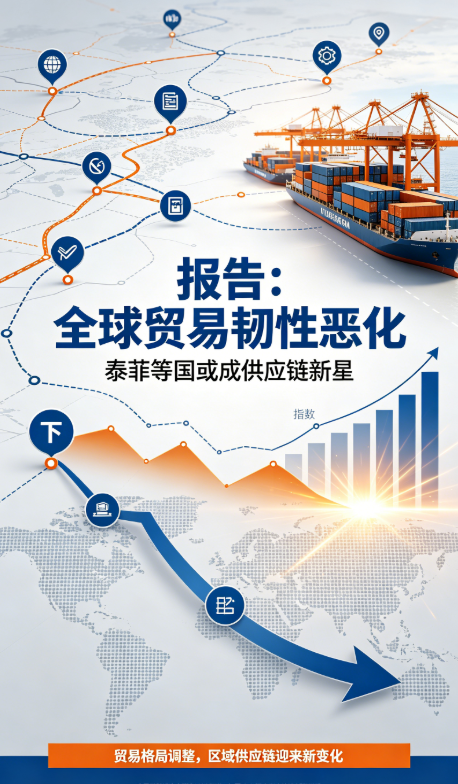
Persistent tensions in the Middle East are pushing the already fragile global shipping and supply-chain network into even greater uncertainty. If the Strait of Hormuz, Red Sea routes, or related energy and freight channels are disrupted, the shock will go beyond transport costs and hit the stability of global manufacturing, logistics and inventory systems. In this setting, the global trade picture is not only about higher risk; it is also creating new opportunities. A report from British risk analysis firm Verisk Maplecroft says one-third of the world's busiest ports and airports are exposed to conflict, environmental and domestic security risks, while trade resilience in major economies has generally deteriorated. Yet under this pressure, economies that have long been underestimated, such as Thailand, the Philippines and Argentina, may actually become potential winners in supply-chain restructuring thanks to their relatively stable industrial base and policy space.
The Global Supply Chain Enters an Era of Reassessment
Over the past decade, globalization was built on low cost, long distance and high efficiency. But frequent geopolitical conflicts, more severe climate disasters and rising trade protectionism are changing how companies choose locations and build networks. Companies no longer look only at labor costs and tax incentives; they increasingly value political stability, port access, energy security, institutional transparency and supply-chain resilience.
That means the traditional "low-cost country" may no longer have an absolute advantage. Economies that can maintain continuous production, respond quickly and isolate risks in an uncertain environment are drawing more attention. Thailand, the Philippines and Argentina are being reassessed precisely because they show traits that fit the new supply-chain era in different ways.
The Philippines: Risks Remain, But Talent Advantages Stand Out
The Philippines has faced plenty of challenges in recent years: corruption scandals over flood-control projects have stirred public anger, and political rifts between the president and vice president have deepened instability. These factors will certainly affect investor confidence. Still, from a supply-chain restructuring angle, the Philippines is far from unattractive.
Its biggest advantage is a young workforce with relatively strong English skills. For fast-growing outsourcing, customer support, financial processing, IT operations and some knowledge-intensive services, language ability and labor availability are often more important than manufacturing cost alone. As more multinational firms spread back-office and middle-office functions overseas, the Philippines has the potential to take on higher-value outsourcing work.
Of course, whether the Philippines can truly become a rising star depends not on short-term political events, but on whether governance can keep up with the demands of economic opening. If firms can build stronger compliance and risk-control systems, political noise may not be enough to cancel out the country's talent advantage.
Thailand: Risks Ease and a Manufacturing Upgrade Window Opens
Compared with some neighboring Southeast Asian economies, Thailand's overall risk trend over the past five years has been downward, which is a major reason it is back on global companies' radar. Thailand has long had a relatively mature industrial base, a well-developed logistics network and strong regional manufacturing support capabilities, with deep experience in autos, electronics and components processing.
Although Thailand also faces structural issues such as an aging population and rising labor costs, its advantage is shifting from "low-cost manufacturing" to "absorbing mid- to high-end manufacturing." Especially as AI-related investment pushes demand for higher precision, stability and supporting capacity in the electronics chain, Thailand may be able to capture higher-value production steps.
More importantly, as global supply chains seek to reduce single-point dependence, Thailand is well placed for a more distributed regional layout. For multinational companies, Thailand is not only a production base; it may also be an important gateway to the ASEAN market. If it continues to improve its business environment and expand skilled labor supply, Thailand's position in future competition will be even more secure.
Argentina: Resources and Agreements Could Be the Breakthrough
In Latin America, Argentina's opportunity comes mainly from its resource endowment and trade agreements. As countries speed up supply-chain planning for critical minerals, energy and clean technologies, Argentina's strategic value in lithium, energy and agriculture is rising. If it can use trade and investment agreements with Europe and the U.S. to further improve its export structure, it could move from a resource exporter to a strategic supplier.
Compared with Southeast Asia, Latin America still lags in large-scale manufacturing and supply-chain density, but that does not mean there are no opportunities. On the contrary, as Western countries try to reduce dependence on China, resource-rich and regionally focused producers are being pulled back into the global layout. Argentina's strength is not in copying the Asian manufacturing model, but in becoming a new supply node for critical minerals, energy and some processing segments.
Of course, Argentina has long struggled with inflation, exchange-rate volatility and macro policy instability, all of which limit its ability to attract large-scale manufacturing investment. If it really wants to benefit from supply-chain restructuring, it must keep pushing on institutional stability, investment protection and infrastructure upgrades.
Conclusion: Resilience Matters More Than Low Cost
Global supply chains are shifting from "efficiency first" to "resilience first." In this round of restructuring, the real winners may not be the lowest-cost countries, but those that can offer a stable political environment, sustainable industrial support and shock-absorbing capacity. Thailand, the Philippines and Argentina each have weaknesses, but that is exactly why their upside deserves more attention.
For companies, future supply-chain design will no longer be about simply getting the cheapest option; it will be about building a multi-center, switchable, shock-resistant global network. For investors, spotting the long-term value of these underestimated economies may be more strategic than chasing short-term hype. The Middle East fires are bringing not only risk, but also a signal that the global production order is being reshuffled. In this change, new "rising stars" may already be taking shape quietly.