


Ohmyhome Divests Loss-Making Brokerage Business: Shifts to Digital Marketing in Search of a New Lean-Asset Growth Path
Keywords: Ohmyhome, Nasdaq, Singapore property, spin-off, digital marketing, loss-making, lean-asset transformation, Ohswiftwing, asset restructuring
Introduction
As global capital markets place greater emphasis on corporate profitability and sustainable growth, restructuring and strategic contraction have become important tools for many listed companies trying to find a new growth curve. Recently, Singapore property agency and services platform Ohmyhome, listed on Nasdaq in the U.S., announced that it will fully divest its persistently loss-making real-estate brokerage and related businesses, and redirect resources to digital marketing services. This move not only marks a major change in the company's business structure, but also shows that under intensified competition and pressure on its traditional business, it is trying to reshape its future with a lighter, more scalable model.
1. Selling the Subsidiary for US$1, Fully Cutting Off Losses
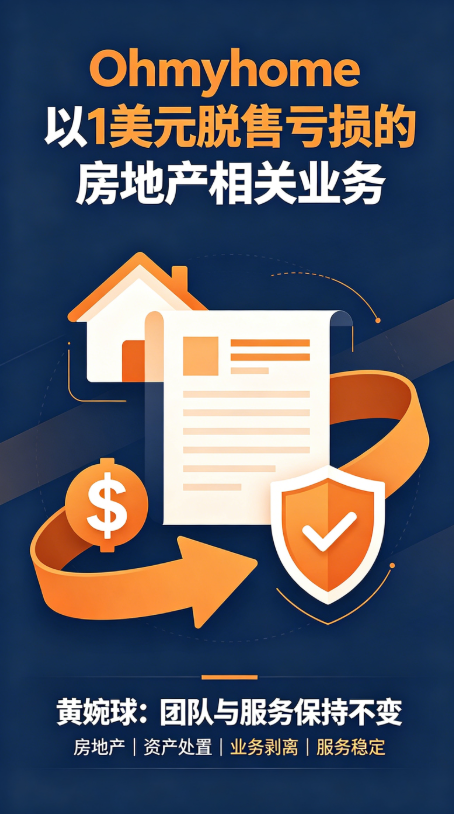
According to a filing submitted by Ohmyhome to the U.S. Securities and Exchange Commission, the company has signed a share purchase agreement with Sterling Oat Ltd. to sell all shares in Ohmyhome BVI, its property-related subsidiary, for US$1. On the surface, the deal amount is extremely small and almost negligible, but what it really shows is not a deep discount sale of assets; it is an active effort by the company to stop losses from its unprofitable business.
The filing said the sale price was based on the subsidiary's net asset position. As of end-March 2026, Ohmyhome BVI's total liabilities had exceeded its assets by about US$14.77 million. That means the subsidiary was clearly insolvent. Keeping it would not only fail to improve financial performance, but could also drag down the parent company's overall profit structure and capital efficiency. For a listed company that remains loss-making, shedding a heavy burden and focusing on more promising businesses becomes a practical choice management has to make.
2. Debt Waiver Also Underway to Repair the Balance Sheet
In addition to selling the equity, Ohmyhome also announced that it will waive a total of S$19,019,173 owed by Ohmyhome BVI, including about S$16.22 million in earlier debt and about S$2.79 million in interest-free loans. The company said in the filing that the debt waiver is in the company's best interests and is mainly intended to strengthen the subsidiary's financial position.
In financial terms, this is really a combination of "sale + debt cleanup." In other words, Ohmyhome is not only cutting the drag of loss-making business on the parent company, but also reorganizing its balance sheet to create room for the remaining business. For the buyer, taking over a high-debt, low-asset entity often means it values future integration or business synergies more than current financial performance. For the seller, getting rid of a money-losing segment helps reduce future operating risk and audit pressure.
At a deeper level, the debt waiver also shows that Ohmyhome is no longer expecting its brokerage and related businesses to turn around in the short term, and is instead taking a more decisive step to pave the way for transformation.
3. Management Says Service Offerings Stay the Same and the Team Will Keep Working
In response to outside attention over the business sale, one of the company's founders, Huang Wanqiu, wrote on LinkedIn that she and her sister Huang Wanpei will continue to lead all of Ohmyhome's businesses, including real estate brokerage, renovation and property management. She also stressed that the brokerage and related-business teams and service offerings will remain unchanged, and that the company will, as always, remain committed to serving customers and partners.
This statement sends two signals. First, divestment does not mean service disruption, so existing customers and partners need not worry too much about the equity sale. Second, the company wants to keep frontline operations stable and avoid customer loss or damage to brand trust during the transition.
Still, in commercial substance, even though management says the "team and service offerings remain unchanged," the equity spin-off has already fundamentally changed the strategic position of this business within the group. Whether it will continue to be equally associated with the Ohmyhome brand remains to be seen. For a company whose brand and platform recognition are key assets, maintaining market trust during restructuring will be one of the keys to a successful transformation.
4. Focusing on Digital Marketing: A New Growth Point in a Lean-Asset Model
Ohmyhome further said that revenue from the subsidiary's brokerage and related businesses has been declining, with persistent operating losses, so after evaluation it decided to divest the business and shift its focus to expanding digital marketing services, including digital strategy development, promotional content creation and multi-channel marketing.
This strategic shift reflects a sharp reading of industry change. Traditional brokerage business usually relies on heavy manpower, offline operations and long deal cycles. It is easily affected by market conditions, rates and regulation, and its revenue can swing sharply while margins come under pressure. By contrast, digital marketing services are more scalable and replicable, with lower marginal costs. Once a stable client base is built, the profit model tends to be more flexible.
Importantly, Ohmyhome did not suddenly enter digital marketing. The company set up a wholly owned subsidiary, Ohswiftwing Pte. Ltd., in Singapore as early as July 2025 to focus on digital marketing services, showing that it had already started preparing for a shift in focus. In other words, this divestment is not just a simple "cut the arm to survive" move; it looks more like a strategic adjustment that was planned and prepared in advance.
From a business logic perspective, Ohmyhome hopes to use digital marketing to enter a broader services market and leverage content creation, traffic distribution and multi-channel promotion to serve more clients beyond real estate. If that cross-sector expansion goes well, it could improve revenue diversification and reduce dependence on a single industry.
5. Financial Pressure Lies Behind the Transformation
Ohmyhome's transformation is not without cause; it is built on years of losses and an unbalanced revenue structure. Financial results show that the company has lost money for three straight years from 2023 to 2025, with net losses of about S$5.52 million, S$4.36 million and S$9.24 million respectively. The 2025 loss widened further, showing that the original business model still had not found a stable path to profit.
In terms of revenue structure, Ohmyhome's digital marketing services generated S$323,525 in 2025, only about 2.64% of total revenue of S$12,241,483. That shows that although the company had begun laying out the new business, the segment was still at an early stage and not yet able to support overall performance. That is precisely why management needed to offload low-efficiency businesses and concentrate limited resources on a more promising growth direction.
But transformation is never a one-step process. Digital marketing is lighter in assets, but competition is also fierce, entry barriers are relatively low, and customer acquisition costs, talent supply and brand influence will all be important factors in deciding success or failure. Whether Ohmyhome can achieve scale in its new lane depends on whether it can keep producing content, building clients and developing differentiated services.
6. The Market's Reaction Is Muted; Investors May Still Be Watching
On the day the news was announced, Ohmyhome's share price closed up 0.11% at US$0.64; but after-hours trading had fallen 4.67% by press time. That suggests the market remains cautious about the company's turnaround direction. Investors usually give an initial positive response to news like "divesting a loss-making business" because it shows management is taking a more practical approach. But the after-hours pullback also suggests the market may still be judging whether the strategy can really improve the company's long-term outlook.
For the capital market, what matters most is not whether the company has told a new story, but whether the new story can turn into sustainable revenue and positive cash flow. If Ohmyhome wants a fresh re-rating, it will need to show clearer financial improvement later on, such as faster revenue growth, narrower losses, or a meaningful increase in gross margin from the new business. Otherwise, even after the divestment, it may only be short-term window dressing rather than a change in investor expectations.
Conclusion
Ohmyhome's decision to divest its loss-making brokerage and related businesses at a very low price is, in substance, a strategic restructuring aimed at the future. By selling the subsidiary, waiving debt and focusing on digital marketing, the company is trying to shed the drag of its old business and move toward a more flexible, growth-friendly lean-asset model. This choice is both a response to real loss pressure and a proactive attempt to reshape the business model.
Still, the transformation path will not be easy. Whether digital marketing can grow into a new core engine remains to be proven over time; and during the business switch, Ohmyhome must also balance customer trust, team stability and capital-market expectations. For this listed company that has posted losses for years, the real test may not be "can it sell the old business," but "can it build sustainable profitability in the new one."
In a market that is highly competitive and changing rapidly, turning decisively is important, but standing firm after the turn matters even more. Ohmyhome's next phase is worth watching closely.