


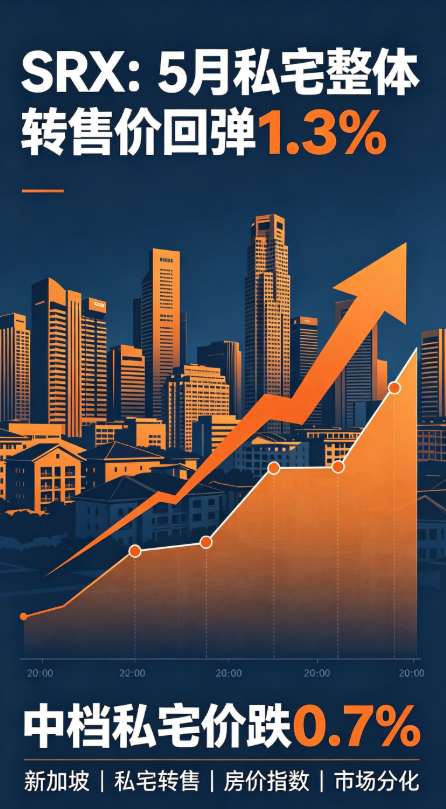
Singapore Private Home Resale Prices Rise 1.3% in May: Demand Remains Resilient as the Market Turns Cautious
Keywords: Singapore private homes, resale prices, resale volume, sub-sales, property market, Core Central Region, mid-tier homes, mass-market homes
Introduction
Singapore's private home resale market showed signs of stabilization in May after falling for two straight months. According to estimated data released on Thursday, June 25, by property portal 99.co and the Singapore Real Estate Exchange (SRX), overall resale prices for non-landed private homes in Singapore rose 1.3% month on month, showing that underlying demand remains solid. But the price rebound was matched by a different picture on volume: resale transactions fell 8.9% from April, suggesting buyers are becoming more cautious as new launches approach and supply gradually increases.
Price and volume moving in different directions is not unusual. The current Singapore private home market continues to benefit from steady housing demand, a strong view of asset preservation, and ongoing family-upgrade demand. At the same time, it is also affected by new launch timing, affordability pressure, and seasonal factors, creating a structural pattern of "steady prices, slower sales." Overall, May's data show the market has not lost support, but the wait-and-see mood on both sides is rising.
Overall Resale Prices Rebound, Underlying Demand Still Resilient
99.co chief data officer Hajin said the May rebound in private home resale prices is a positive sign, indicating demand remains firm. More importantly, resale prices were up 3.7% from a year earlier. That result not only matches most industry forecasts for 2026, but also sits near the upper end of the prediction range, showing that the price support built over the past period is not a short-term fluctuation, but rests on a strong housing-demand base.
At the macro level, Singapore's private home market has drawn sustained attention in recent years because of its scarcity, policy stability, and long-term asset-allocation role. For many buyers, private homes are not just a place to live but also a way to preserve wealth. Even with uncertainty from rates, the economic outlook, and new supply, core demand has not clearly weakened, which is a key reason prices could rebound quickly in May after declining.
But rising prices do not mean the market has turned fully strong. Compared with the mild price rebound, the drop in transaction volume better reflects what buyers are thinking. With more launches coming this year, some buyers prefer to watch first and decide later, especially upgrade buyers, who must weigh timing and cash flow more carefully.
Mixed Performance Across Segments, Core Central Region Leads
By segment, the biggest highlight in May came from the Core Central Region (CCR), where high-end private homes are located. Resale prices there rose 3.7%, the strongest among all regions, showing that demand from high-net-worth buyers still has some support. CCR homes are usually in prime locations, with limited supply and stronger scarcity and value-preservation features, so they often prove more resilient when the market weakens.
Mass-market private homes in the Outside Central Region (OCR) also did well, with prices up 1.6%. That suggests essential demand and upgrade demand are still keeping the mass-market segment active. For many first-time move-up buyers, mass-market homes offer strong value between price and location, making them an important part of the overall market.
By contrast, resale prices for mid-tier private homes in the Rest of Central Region (RCR) fell 0.7%, nearly erasing April's gain. Mid-tier homes were once one of the most active segments, because they combine location, space, and affordability and have long been popular with local families. However, with higher price sensitivity and more buyer choice, this segment is more easily affected by new-launch competition and caution, so short-term swings are more visible.
It is worth noting that in April, resale prices for high-end private homes and mass-market homes fell 2.8% and 0.3% respectively, while mid-tier homes rose 0.8%. May's rebound shows that rotation across segments is very clear: the market is not rising in one direction across the board, but is constantly searching for a new balance in different price bands.
Lower Resale Volume Reflects Seasonal Effects and Supply Expectations
Private home resale activity slowed noticeably in May, with overall volume falling from 1,086 units in April to 989 units, down 8.9%. On the surface, that seems to signal weaker demand, but looking at historical patterns and the market backdrop, it is closer to a phase of adjustment than to a real trend reversal.
Hajin noted that May is usually a softer month for resale activity, and this year's May volume was still 0.7% higher than a year ago, showing that demand has not disappeared, only slowed in pace. In other words, lower volume does not necessarily mean buyer confidence has fallen sharply. It may simply reflect buyers waiting for a better entry point and the "diversion effect" of rising new supply.
Wang Shanting, head of research at Newmark Real Estate, also said that several attractive new projects are set to launch in the Upper Thomson Road, Jalan Kuling and Dunearn Road areas, which may keep some buyers on the sidelines and affect resale demand. That view hits the market's key issue: when quality new launches arrive, the resale market is easily influenced by comparison effects, especially for buyers who care about location, brand, and amenities. The substitution between new launches and resale units becomes stronger.
From a buyer-behavior angle, the slowdown in the resale market is not surprising. Although borrowing costs have eased from prior highs, the overall cost of funds is still not low; at the same time, home prices are already at relatively high levels, so buyers pay closer attention to price per square foot, future upside, and household cash-flow planning. As a result, even with real demand in the market, actual transactions may still be delayed by a "wait and see" mindset.
Sub-Sale Share Rises, Showing Speculation and Arbitrage Still Matter
In May, sub-sale transactions accounted for 5.7% of total resale transactions, up from 4.4% in April. The change is not huge, but it is worth noting. Sub-sales usually mean a buyer resells a unit before completion, which may involve investment gains, asset reallocation, or an adjustment to market expectations.
The rising share of sub-sales suggests that some arbitrage room and trading activity still exist in the market. It also hints that some buyers remain cautious about future price trends and are willing to lock in gains at the right time. For the market, an increase in such transactions usually means views on price direction are diverging: some are still bullish, while others prefer to lock in profits before supply rises further.
Second-Half Outlook: Cautiously Optimistic, With Both Price Support and Supply Pressure
Looking ahead to the second half of the year, most industry players believe Singapore's private home resale market will remain in a "cautiously optimistic" mode. Hajin said supply and affordability will continue to drive the market. In particular, several large new projects will be launched in the Outside Central Region in the second half, and market response will be an important test of demand strength. If opening-weekend take-up is strong, it suggests upgrade demand remains firm; if response is soft, it may mean prices are already close to the affordability ceiling.
Wang Shanting warned that 5,371 new private home units will be completed between the second and fourth quarters of this year, bringing more supply and more choices to the market. As the number of comparable units rises, resale homes may become relatively more attractive, especially for buyers who want immediate move-in. Still, she said June is still the school holiday period, so market activity will be somewhat affected, and resale transactions are expected to recover more clearly only in the second half.
In sum, the market over the next few months will depend on three key variables: new launch sales performance, interest-rate and financing conditions, and buyer acceptance of pricing. If new launches are absorbed steadily, the resale market may stay stable; if new launches are priced too high or underperform expectations, some buyers may return to the resale market and provide support.
Conclusion
May's 1.3% rise in Singapore private home resale prices brought a small stabilizing signal after two straight months of declines. Although resale volume fell 8.9%, year-on-year performance and segment trends suggest private home demand has not weakened materially. Instead, strong resilience is showing across regions and price bands. CCR-led gains, steady mass-market growth, and only a mild pullback in mid-tier homes indicate the market is undergoing structural divergence rather than a broad correction.
Looking ahead, as more new projects and completed units enter the market, buyers will have more choices and the resale market will face more direct competition. Still, with housing demand stable and supply being released gradually, Singapore's private home market retains support. Overall, the outlook is not bearish; it is entering a more cautious phase that places greater weight on price, timing, and affordability.