


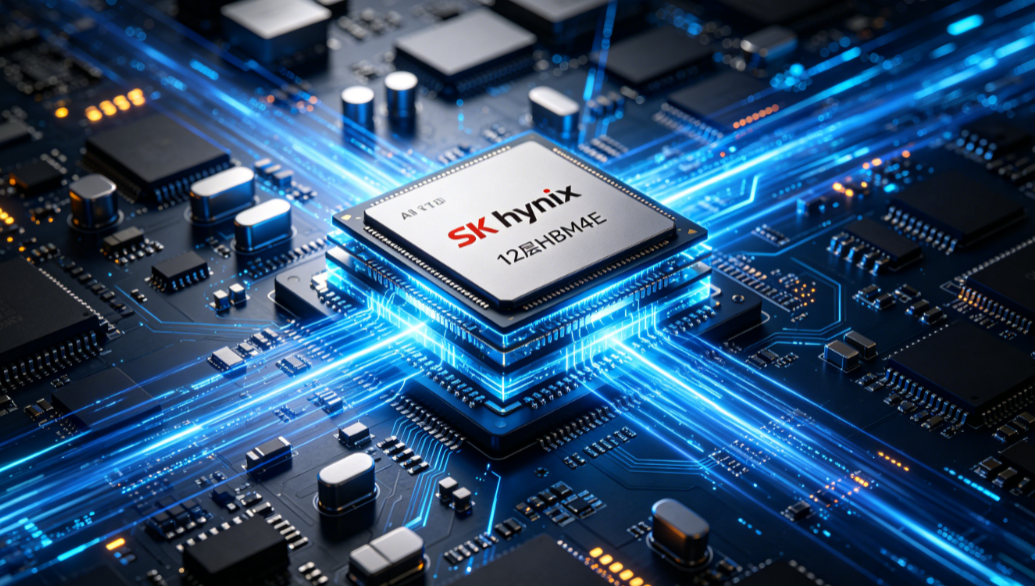
SK Hynix Delivers HBM4E Samples: AI Memory Competition Enters a New Phase
Keywords: SK Hynix, HBM4E, AI chips, DRAM, high-bandwidth memory, Nvidia, Samsung, Micron, AI data centers
Introduction
Against the backdrop of rising global demand for AI compute, high-bandwidth memory (HBM) has moved from a supporting component to a core part that determines the upper limit of AI chip performance. Recently, SK Hynix announced that it has delivered 12-layer stacked samples of its next-generation AI DRAM, HBM4E, to major customers. This progress not only means it remains a leader in HBM technology iteration, but also further strengthens its strategic position in the AI chip supply chain.
For the fiercely competitive memory-chip industry, sample delivery is not just a technology showcase. It is also a concentrated expression of industrialization capability, customer coordination capability, and market influence. SK Hynix’s move clearly sends one message: competition around the AI compute base layer has upgraded from a simple chip-performance contest into a systems-level battle covering process, power efficiency, stability, and delivery pace.
HBM4E Sample Delivery Sends a Signal of Technical Leadership
The biggest highlights of SK Hynix’s HBM4E samples are the 12-layer stacking structure and the simultaneous improvement in performance and power consumption. Compared with the previous HBM4 generation, HBM4E can reach up to 16 Gbps per pin and improve power efficiency by more than 20%, meaning it can exchange more data per unit of power and significantly ease the “strong compute, weak memory” bottleneck in AI training and inference.
In large-model training, GPUs and accelerators keep getting stronger, but if memory bandwidth and latency are not optimized at the same pace, compute resources are wasted because data cannot be supplied fast enough. That is exactly where HBM4E matters: higher bandwidth, lower latency, and more stable operation under heavy loads help AI systems move data more efficiently and raise overall compute utilization.
SK Hynix also said the product uses the latest interface and design optimizations, reducing data-transfer latency while maintaining stable operation under high bandwidth conditions. That is especially important for AI data centers and large-scale compute platforms. As generative AI, autonomous driving, and scientific computing continue to expand, customers no longer need memory that merely has enough capacity; they now demand sustained performance, controllable cooling, and long-term reliability.
MR-MUF and 12-Layer Stacking Reflect Manufacturing Barriers
From a manufacturing perspective, HBM4E competition is not just about specs; it is also a contest in advanced packaging capability. SK Hynix said the product is built with advanced MR-MUF technology, enabling 48 GB capacity in a 12-layer structure while maintaining structural stability.
MR-MUF, or mass reflow mold underfill, is one of the key processes in HBM stacked packaging. It injects protective material between chip layers to strengthen structure, improve thermal stability, and reduce the stress and damage that may occur during stacking. For HBM products with ever-higher layer counts and integration levels, this process capability directly determines yield, reliability, and mass-production feasibility.
More noteworthy, SK Hynix also said HBM4E’s heat resistance improved by 17% versus HBM4. In high-performance computing environments, memory chips run for long periods under high temperature and heavy load, so cooling and stability often become the key constraints on system reliability. Better heat resistance not only helps extend chip life, but also reduces the extra cooling investment required in data centers, creating real economic value for customers.
From an industry perspective, HBM products are no longer simple improvements at the packaging level. They are the result of the joint evolution of materials, processes, design, and system compatibility. SK Hynix’s ability to be the first to deliver 12-layer HBM4E samples shows that it not only has advanced DRAM design capability, but also a strong barrier in stacked manufacturing and packaging engineering.
Positive Market Reaction Further Strengthens the AI Memory Landscape
After the announcement, SK Hynix’s stock rose 4.17% in the Korean market, while Samsung Electronics edged up 0.87%. Year to date, SK Hynix’s share price has climbed 287%, reflecting strong market recognition of its leading position in the AI memory segment.
Today, SK Hynix has become one of Nvidia’s main HBM suppliers, occupying an important place in the AI accelerator ecosystem. At the same time, Samsung and Micron are also pushing hard in HBM to compete for market share in the next product generation. For the three major players, the focus has shifted from base capacity to development progress, customer adoption speed, and scaled delivery capability.
Especially in the AI chip market, leading customers typically screen suppliers through multiple stages such as sample validation, joint development, reliability testing, and large-scale adoption. Whoever completes sample delivery earlier and passes validation has a better chance of winning orders in mass production. SK Hynix’s announcement of HBM4E sample delivery is an important step in capturing the next market opening.
From a broader perspective, competition in the HBM market is not only about corporate earnings; it will also affect the supply efficiency of global AI infrastructure. As AI applications expand from the cloud to edge computing, industry models, and high-performance computing clusters, HBM supply capacity and technical maturity are becoming important variables that constrain the pace of AI industry expansion.
Conclusion
SK Hynix’s delivery of 12-layer HBM4E samples is both a major technical advance and a strategic move to consolidate market leadership. Whether it is the 16 Gbps transmission speed, the more than 20% gain in power efficiency, the 48 GB capacity, or the 17% improvement in heat resistance, all of it shows that HBM is evolving quickly toward higher performance, stronger stability, and better energy efficiency.
For SK Hynix, this not only means it continues to hold an advantage in the HBM race, but also that it is gradually transforming from a memory supplier into a full-stack AI memory solutions provider. President Ahn Hyun’s emphasis on technological leadership and partner collaboration reflects the core logic of semiconductor competition today: the companies that truly win the market in the future will not only have advanced chips, but will also be able to integrate technology, manufacturing, and ecosystem efficiently.
With AI compute demand still growing rapidly, the arrival of HBM4E may only be the beginning of the next memory revolution. SK Hynix’s early debut has clearly secured it a more favorable position in this long-term competition.