


Why the Gold Market Is Far Larger Than Other Precious Metals — A Comparative Analysis Based on 2022 Trading Volume
Keywords: gold market; precious metals; market size; average daily trading volume; liquidity; asset allocation
Introduction
Within the precious-metals market, gold has long held an irreplaceable core position. Whether viewed as an international reserve asset or measured by financial trading activity, gold is clearly ahead of silver, platinum, palladium, and other precious metals. Especially amid rising global uncertainty, shifting inflation pressures, and frequent geopolitical risks, gold is not only a safe-haven tool but also an important anchor in global capital allocation. The size of a market directly reflects an asset’s liquidity, the breadth of its participant base, and the maturity of its financial characteristics. Based on 2022 market performance, the gap between gold and other precious metals becomes especially clear.
Gold’s Scale Advantage
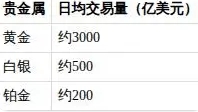
In terms of trading scale, the gold market is far larger than other precious metals. In 2022, global gold trading volume reached the level of hundreds of billions of U.S. dollars per day, covering spot, futures, swaps, ETFs, and OTC trading. Behind this are not only central banks’ reserve-management needs, but also financial institutions’ allocation needs, institutional investors’ hedging needs, and retail investors’ store-of-value needs. The diversification of market participants has made gold a highly mature global market with exceptional depth.
By comparison, the markets for silver, platinum, and similar metals are much smaller. Although they also have commodity and investment characteristics, their status in global reserve assets is limited and their financial-market attention is not as strong as gold’s. Especially during periods of macro uncertainty, capital tends to flow to gold first rather than to other precious metals, further reinforcing gold’s trading concentration and liquidity advantage.
Why Trading Volumes Differ So Much
The reason gold has such a massive market size begins with its historical role. Gold has long been regarded as a symbol of wealth, and in the modern financial system it has been given the roles of “ultimate means of settlement” and “reserve asset.” Central banks hold gold not only to diversify assets, but also to strengthen confidence in their currencies and external payment capacity. Continuous central-bank allocation forms a stable and long-term demand base for the gold market.
Second, gold has extremely strong financial characteristics. Unlike silver and platinum, which also have industrial uses, gold’s pricing is more directly influenced by global capital flows, real interest rates, the dollar’s direction, and changes in risk appetite. This makes gold more tradable in capital markets and easier to become a key instrument in macro trading strategies. The existence of a large number of derivatives further expands the trading depth and reach of the gold market.
Third, gold enjoys a higher level of market recognition and global universality than other precious metals. Whether in developed or emerging markets, gold is widely accepted, and its pricing reference system, trading rules, and settlement mechanisms are more complete. This high degree of standardization and global consensus gives gold liquidity advantages that other precious metals struggle to match.
Market Features of Other Precious Metals
Silver, platinum, palladium, and other precious metals may have smaller markets, but each still has its own unique value. Silver has both precious-metal and industrial-metal characteristics and is heavily influenced by solar power, electronics manufacturing, and photovoltaics; platinum and palladium are more closely linked to auto catalysts, chemicals, and high-end manufacturing. As a result, their prices are influenced not only by financial factors, but also by the health of the real economy.
For this reason, other precious metals usually show more cyclical performance, and their trading volumes are less stable than gold’s. For investors, this means greater price elasticity, but also shallower market depth and weaker safe-haven characteristics. In other words, other precious metals are more like assets with strong industry characteristics, while gold is the classic asset with global financial characteristics.
Implications for Investing and Asset Allocation
From an asset-allocation perspective, the gold market’s scale advantage means better liquidity, lower transaction costs, and a more mature price-discovery mechanism. For institutional investors, gold is better suited as a core defensive asset in a portfolio, used to hedge inflation, exchange-rate volatility, and systemic risk. For ordinary investors, gold is also more suitable for long-term allocation because of its high market maturity.
Of course, a larger market does not mean lower volatility. Gold prices are still affected by interest-rate policy, the U.S. dollar, and global risk appetite. But because the participant base is broad and the trading mechanism is well developed, gold prices tend to be more continuous and representative. By contrast, smaller precious-metals markets are more vulnerable to single-factor shocks, leading to larger swings and more concentrated risk.
Conclusion
Overall, the 2022 precious-metals market clearly showed the size gap between gold and other precious metals. Thanks to its reserve-asset status, global liquidity, derivatives system, and broad market participation, gold generated a trading volume far beyond silver, platinum, and other metals. Other precious metals still have value in industrial applications and niche investment areas, but in terms of market size, liquidity, and international recognition, they still cannot compare with gold. That is why gold remains the core of the global precious-metals market and the key starting point for understanding precious-metals allocation logic.